Marginal rate of technical substitution

The marginal rate of technical substitution (MRTS) shows how much of one input a firm can give up while increasing another input, without changing its level of output. It explains the trade-off between inputs - usually labor and capital - inside a production process.

How MRTS works

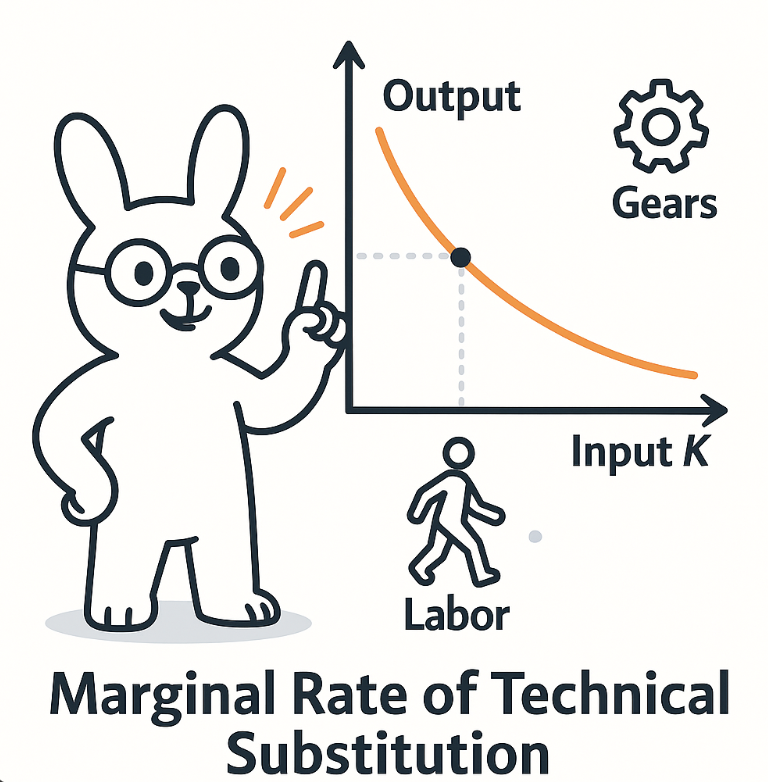
MRTS shows how a firm can swap one input for another while keeping output the same. It’s measured along an isoquant, a curve showing all the combinations of labor (L) and capital (K) that produce a fixed level of output.

As you move along an isoquant, you’re trading one input for the other. MRTS tells you how much extra labor is needed when you reduce capital (or how much capital you must add if you reduce labor) while keeping output unchanged.

The formula is:

MRTS = MPL / MPK,

where MPL is the marginal product of labor and MPK is the marginal product of capital.

This ratio shows how easily one input can replace another at that specific point on the isoquant.

Early on, substitution is easy, but as you continue swapping inputs, the trade-off becomes steeper — meaning each unit of capital removed must be replaced with more and more labor. That’s why MRTS typically decreases as you move down the isoquant.
How Alice could help

MRTS can feel abstract because it mixes isoquants, marginal products, and ratios. Alice turns your material into clear notes, summaries, and quizzes, helping you see how inputs can replace each other and how MRTS changes as you move along an isoquant. You focus on understanding the logic instead of getting stuck on the symbols.

Try Alice for free

Example of MRTS in real life

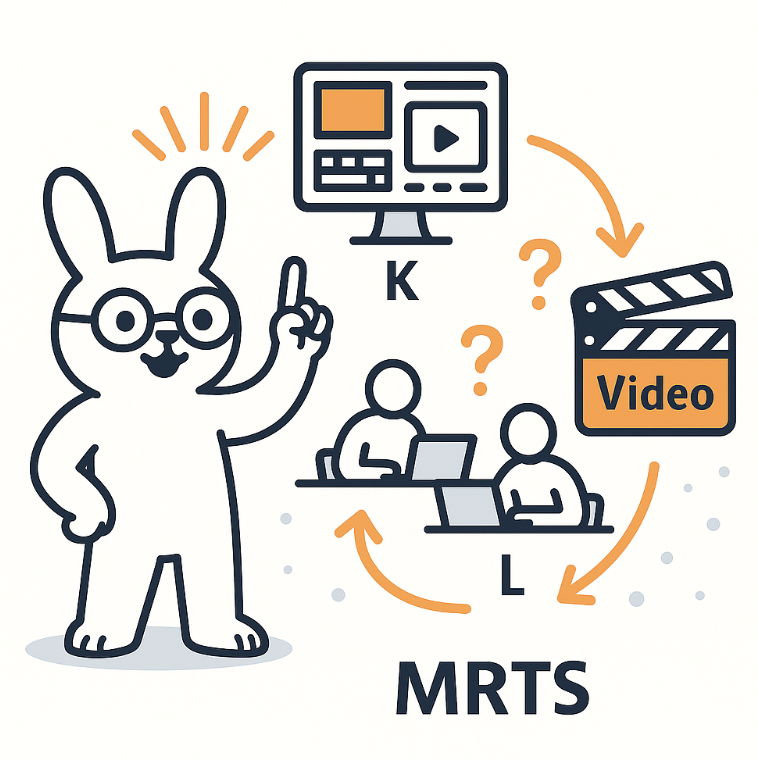
Imagine that your school’s media team needs to create a short video. They can use labor (L) - students editing manually - or capital (K) - software and equipment that automate parts of the process.

If the team loses access to one editing computer, they can still finish the video by adding more student editing hours. MRTS tells them how many extra labor hours they need to replace the lost capital while keeping the output (the completed video) the same.

As they substitute more and more labor for capital, the trade-off becomes harder - each missing computer requires even more student hours. That changing trade-off is exactly what MRTS measures.

Why MRTS matters

Real-world use

MRTS helps firms decide how to combine labor and capital in the most efficient way - like choosing whether to hire more workers or invest in better equipment.

Relevance

It shows how flexible a production process is and how easily inputs can replace one another, which is essential for understanding cost minimization and production decisions.

Impact

By understanding MRTS, businesses can avoid overspending on one input when another could achieve the same output more cheaply, improving productivity and lowering costs.

Key concepts in microeconomics

Still have questions?

How do you calculate MRTS?

You divide the marginal product of labor by the marginal product of capital: MRTS = MPL / MPK. This tells you how many units of labor replace one unit of capital without changing output.

Is MRTS the same as MRS?

No. MRTS is about substituting inputs in production (like labor and capital), while MRS is about substituting goods in consumption. One belongs to firms, the other to consumers.

Why does MRTS usually decrease along an isoquant?

Because inputs aren’t perfect substitutes. The more you replace capital with labor, the harder it becomes to keep output the same, so you need increasingly more labor to make up for each lost unit of capital.

What does MRTS tell firms in real life?

It helps firms decide whether to use more labor or more capital. By understanding the trade-off, they can choose the cheapest input combination that still produces the desired output.

Try Alice, make complex trade-offs easier to understand

MRTS involves isoquants, marginal products, and input substitution. Alice turns your material into clear notes, summaries, and quizzes so you can quickly grasp how firms balance labor and capital to keep output the same.
Try it for free today